
Project Overview
Design a new platform to track and identify the best sites for clinical trials worldwide, replacing a mostly legacy manual processes.
CLIENT QUOTE
Jonathan Crowther – Head of Product (Site Intelligence Team)
“… Anton’s approach to conducting end user interviews was exemplary. His ability to empathize with users and extract insightful information significantly shaped our understanding of their needs … Anton’s contributions to ‘Centaur’ were pivotal in its success. We are fortunate to have had Anton as part of our team and are immensely grateful for his exceptional work.”
IMPACT
“The intuitive UX design work greatly contributed to time to market for new & existing drugs with improved efficiency and quality in the site selection process for clinical trials and studies”
What and How I contributed
UX Design & Strategy Leadership
How did I contribute
Met with Senior Management & Stakeholders on a weekly basis; about learnings with users, design decisions, and key strategy decisions
Introduced User Research to the Organization
How did I contribute
Before my involvement, User Research or involvement was almost non-existent. Many users felt left out. I successfully convinced management that we need to do the research and user testing of designs and they let me implement those processes.
Look at existing and legacy tools
How did I contribute
Users were utilizing tools and sites within the company as well as online (public). I spent time with all types of users to understand the use and pain points of these tools, as well as what we can develop inhouse (with tech input) to replace tools that weren't working well for users.
User Journeys and more
How did I contribute
Via user research, I was able to map the various user journeys and explain my learnings to the stakeholders, data scientists doing AI, and developers on the team to much appreciation.
Prototyping
How did I contribute
I created hi-fidelity prototypes for users and buy-in from stakeholders and used feedback to iterate the designs further. I sometimes even created low-fi prototypes using Balsamiq in really early stages of the project, as it really helps convey a workflow.
User Testing
How did I contribute
Using the prototypes, I conducted testing with users and further developed the designs from feedback.
Designed Applications with Dashboards & Workflows
How did I contribute
The output of all the UX design work was creating new, intuitive, applications with dashboards and often complex workflows
Create Design System
How did I contribute
A project of this scale eventually required a design system, which was also shared with the developers so they could also leverage to do some things on their own for minor changes.
Worked closely with AI Data Scientists
How did I contribute
Often Data scientists would create their own simple prototypes which I would take to the next level, often asking the scientists to add some functionality or features; and further the UX/UI designs for new AI features introduced into the platform.
Becoming product SME !
How did I contribute
Over several phases of the project, I became so familiar with the product and sort of became the SME; to the point where new hires in the company were directed to go to me by the head of product to get trained - i.e. ``Go talk to Anton, he knows the product better than most``.
- Old manual processes
- Users created their own personal tools
- Little transparency
- Reliance on third party tools without being able to customize
- Tracking progress was hard
- No way to easily share data with others
- No management oversight into study progress

- Cluttered UI
- Overly complex
- No integrated workflow

- Not easily accessible to team
- Harder to track versions
- Lacking data visualisations
- Version control and history issues
- No integrated workflow
Top Business Goal: Deliver products to market more efficiently via digital transformation that provides more efficient, “intelligent” and higher quality site selections for studies and clinical trials.
Design one cohesive and transparent platform
Eliminate the use of Excel and manual error-prone processes
Integrate multiple approvals/checkpoints into the workflow
Design simplified data visualisations and modules keying in on the presenting the right data points allowing the specialists to analyse the sites more efficiently


- Educate client in design thinking methodologies & practices
- Advocate the use of visual tools to convey and iterate on ideas
- Run and facilitate various workshops
- Emphasis the user’s needs and the bigger picture goals
- Encourage the team members to create boards with ideas
Understand Business and Value Proposition
Understand our users – tasks, workflows, pain-points, missing features
Workshop facilitation – Define Features, Information Architecture, User Flows, Site Map, Identify valuable site insights
Design – start with Low-Fidelity and iterate, then High-Fidelity, Create UI library
User Testing & Demos (improve designs based on feedback)
Tech Handoff
Conduct Senior Management Design Meetings
- Ran design meetings with senior management weekly
- Updated management on user findings and approach to get buy-in
- Set agenda with team
Demos and End-of-Design-Sprint Meetings
- Conducted bi-weekly end of sprint meetings with stakeholders and technology (developers) showing prototypes
- Walk the audience through the overall design architecture with a prototype use-cases
- Identify missing use cases
- Educated developers and tech management on functionality
Design Meetings and Sprints



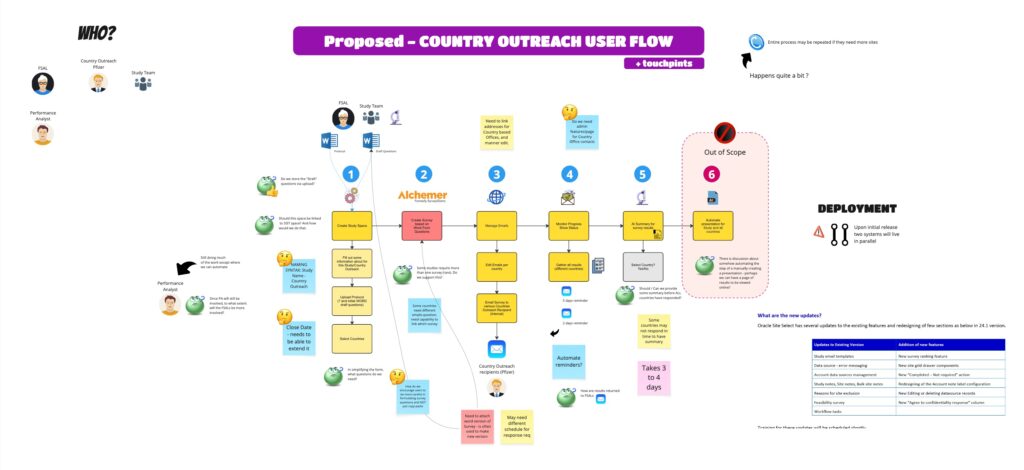

Using MIRO (most people were remote)
- Information architecture
- Site maps & user flows
- Personas and user insights
- Card sorting workshops
- Ideation
- Impact mapping
Once we were in a good place with the first area of the design prototype, I conducted user testing for the different phases (design areas) of the project
- 8 – 12 users in various roles (ongoing)
- 2 hands-on lead specialists, and 6 other specialists (secondary users)
- Moderated testing of clickable prototype for different usecases
- Obtain confirmation that we were on right track with the designs !
User Persona

User Testing & Research


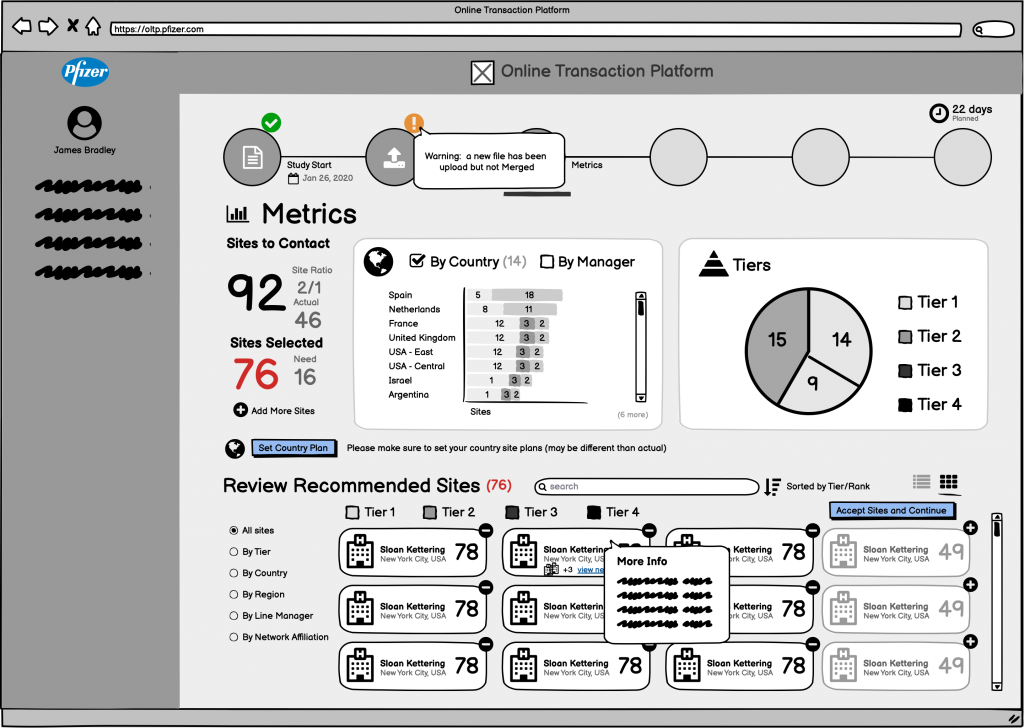


For many of the pages of the workflow, we introduced KPI’s on the top of the page to help the user interpret key data points pertaining to their filtering and other selections being made. I was able to introduce several data points here that were beneficial to the user and not originally identified by product or users.

 Previous Project
Previous Project